
Sedimat™ is a fully biodegradable in-stream sediment control mat used to protect Irish rivers, streams, and watercourses during construction works such as pipeline installation, culvert replacement, ditch maintenance, and bridge work. Available nationwide from SSI Environmental Dublin, Sedimat™ traps up to 80% of disturbed streambed sediment, protecting fish habitats and ensuring compliance with the Water Framework Directive and Irish Fisheries legislation.
Key Product Specifications
| Specification | Detail |
| Dimensions | 1.20m x 3.00m per mat |
| Construction | 3-layer: upper jute mesh / wood wool core / lower hessian |
| Sediment Capacity | 225–450kg per individual mat |
| Sediment Trapping Rate | Up to 80% of disturbed streambed fines (field-tested) |
| Installation Method | Staked or weighted to streambed; laid flat does not impede water flow |
| Post-Use | Fully biodegradable; stake to bank and seed for revegetation |
| Stream Width Range | Tested in streams 10–75 feet wide |
| Water Velocity Range | 0.8–3.3 feet per second (field validated) |
How to Install Sedimat™ (5 Steps)
- Assess the site: measure stream width and identify the downstream work area.
- Lay mats on the streambed immediately downstream of the work zone. Multiple mats can be placed side by side or overlapped for wider streams.
- Secure using stones or stakes. Mats lie flat they do not raise water levels or disrupt flow velocity.
- Proceed with construction. Disturbed sediment settles into the mat layers as water flows over them.
- After works complete: remove mats, stake vertically to the stream bank, and sow with appropriate Irish native seed mix. Biodegradation provides a seedbed for immediate bank stabilisation.
Why Sedimat™ Matters for Irish Fisheries
Ireland’s rivers and streams support nationally protected salmon and trout populations. In-stream construction, even for short durations, can raise fine sediment concentrations above levels tolerated by salmonid spawning beds. Research confirms that sediment fines above 24% in spawning gravel cause major declines in egg survival. Sedimat™ holds post-construction sediment levels below 15% within safe limits for trout reproduction.
Sedimats™ are used in waterways during in-stream construction activities (such as pipe laying or dredging) to trap disturbed sediment that may pollute aquatic habitats downstream. Its easy to get in touch with us by just searching for Sedimat supplier Ireland.
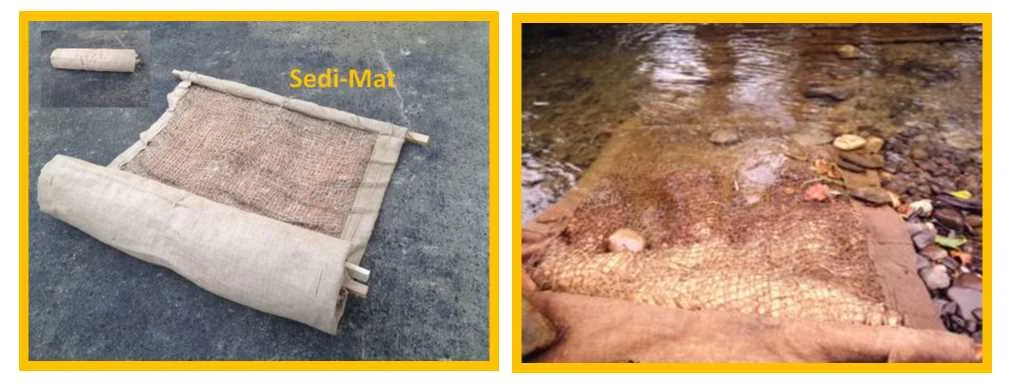
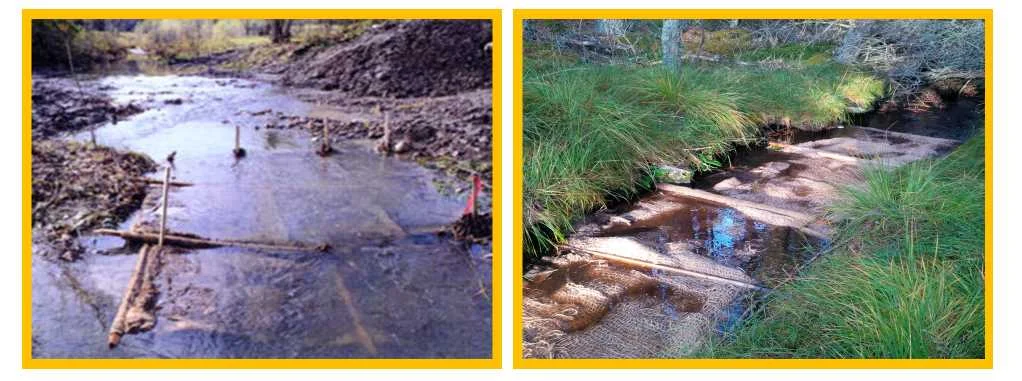
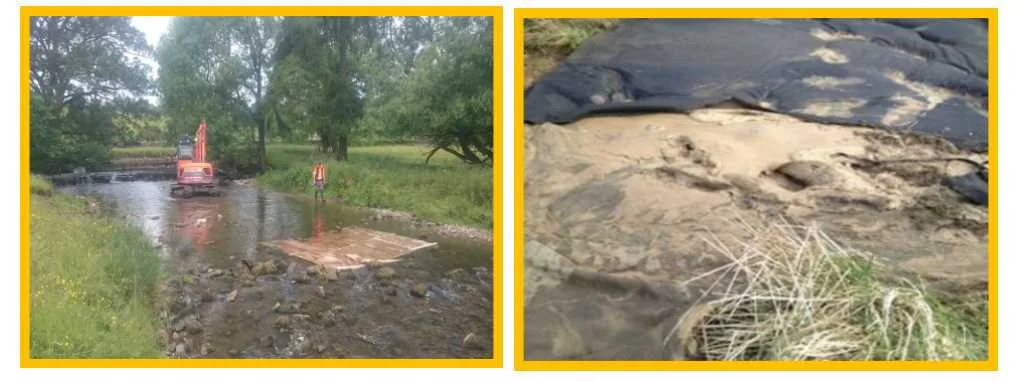
They are a simple, yet effective, biodegradable matting, which are fixed to the stream bed, and do not impede
water flow.
Sedimat™ is an effective tool for the protection of streams from sedimentation damage during in stream
construction activities such as utility installation, culvert replacements, ditch maintenance, and bridge work.
It is a flat 1.20 x 3.00m pad which is laid singly or in multiples on the streambed immediately downstream of the
worksite
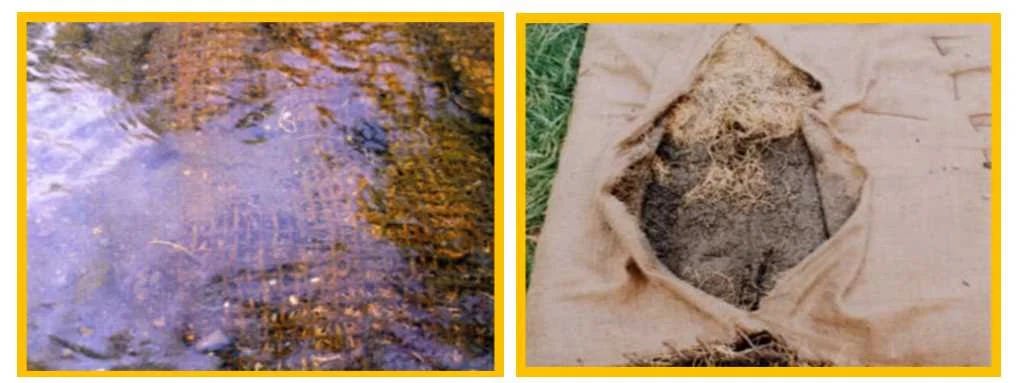
Sediment disturbed by construction is carried along the streambed by the current until it encounters Sedimat™.
The sediment then settles through the upper layer of jute mesh and into a layer of wood wool. A lower layer of
hessian prevents the sediment from escaping. After construction is complete, the mats are removed and can be
staked to the stream bank and seeded to provide immediate stream bank stabilisation. Because the mats are
entirely biodegradable there is no need for disposal. The sediment mixed with the rotting wood wool provides a
seedbed for germination and growth of the seed mix.
Sedimat™ is packaged individually and is easy to store, handle and transport. It can be installed on a streambed
using either stones or stakes and can be placed in any configuration or number to provide desired coverage. It
may be used alone or in conjunction with other methods of stream protection such as coffer dams, culverts
or silt screen.
Sedimat™ was developed and tested under field conditions at eight different streams in central and western New
York State during 1992.
The amount of fine sediment (sand, silt and clay) in the streambed immediately
downstream from the work sites was measured before and after the construction. At seven of the sites, the
disturbance was the excavation of a 4 feet deep trench for the installation of a natural gas pipeline which was
followed immediately by backfilling. At the eighth site the disturbance was extensive hand digging by shovel.
These streams varied in width from 10 to 75 feet and in depth from 6 to 24 inches. Velocities ranged from 0.8 to
3.3 feet per second. Trout were present in most of the watersheds, if not at the test sites specifically. Before
construction, the average percent of sediment fines in the streambed just downstream of the work site was 12.2%.
After construction, it rose slightly to 14.7%. Both concentrations of sediment represent levels conducive to trout
reproduction (egg survival). In contrast, there were locations at six test streams that were subject to the
disturbance but which were not protected by the mats. These were primarily areas between the edge of the trench
and the upstream edge of the mats, or off to a side where mats were purposely not laid. After construction, the
average percent of sediment fines at these unprotected sites rose from 11.5% to 24%. This post construction level
of sedimentation is an amount which has been repeatedly documented to cause major declines in trout
reproductive success.
A comparison of the two before and after sediment concentrations indicates the mats
trapped about 80% of the disturbed sediment and prevented or minimized adverse impact to trout reproduction.
Individual mats were able to trap and remove between 225 and 450kg of sediment each and did not interfere with
construction operations. Because they were laid flat on the streambed, they were not affected by water velocity,
nor did they raise water levels and thus flood the work area.
To enquire about this product – call us on 01 8665676 / 087-9367065 or contact us here
FAQ
Q: What is a Sedimat and how does it work in streams?
A: A Sedimat™ is a biodegradable 3-layer mat placed on a streambed downstream of construction activity. As disturbed sediment travels with the current, it settles into the jute mesh and wood wool layers. The lower hessian base prevents re-suspension. After works, mats are removed and can be seeded to stabilise the stream bank.
Q: How much sediment can a single Sedimat trap?
A: Each 1.2m x 3.0m mat can retain between 225 and 450kg of sediment, with field testing across 8 New York state streams demonstrating an average trapping efficiency of 80% of disturbed streambed fines.
Q: Does Sedimat block water flow in the stream?
A: No. Sedimat™ lies flat on the streambed and does not raise water levels or impede flow velocity. It was specifically designed not to interfere with construction operations.
Q: Is Sedimat™ compliant with Irish environmental regulations?
A: Yes. Sedimat™ supports compliance with the EU Water Framework Directive (S.I. No. 272 of 2009), EPA Pollution Prevention Guidelines, and the Fisheries (Amendment) Act in Ireland, which prohibits actions likely to cause harm to fish habitats.