Silt & Sediment Control Ireland

Silt & Sediment Control Ireland

Silt pollution is Ireland's most widespread construction related water quality problem. Every time disturbed earth is exposed to rainfall on a construction site, it generates turbid, silt laden runoff. When that runoff reaches a drain, stream, or river, it smothers fish spawning beds, suffocates invertebrates, reduces dissolved oxygen, and can destroy a watercourse's ecological quality in hours.

SSI Environmental has been providing silt and sediment control equipment to Irish construction sites for 25 years. Our range includes the Terrastop silt fence system, the patented, award winning SSI Silt Sump, an Irish developed innovation that has transformed sediment management on hundreds of Irish sites, coir mesh erosion blankets, and settlement solutions for larger sites. This page covers the full SSI sediment control range, when each product is used, and what Irish regulatory requirements apply.

Silt curtain and silt control barriers used for sediment control on Irish construction and watercourse projects
Silt curtain and silt control barriers used for sediment control on Irish construction and watercourse projects.
Sediment control silt fence installed in Ireland to prevent construction runoff entering a watercourse
Sediment control silt fence installed in Ireland to prevent construction runoff entering a watercourse.

The SSI Silt Sump: Ireland's Award Winning Sediment Control Innovation

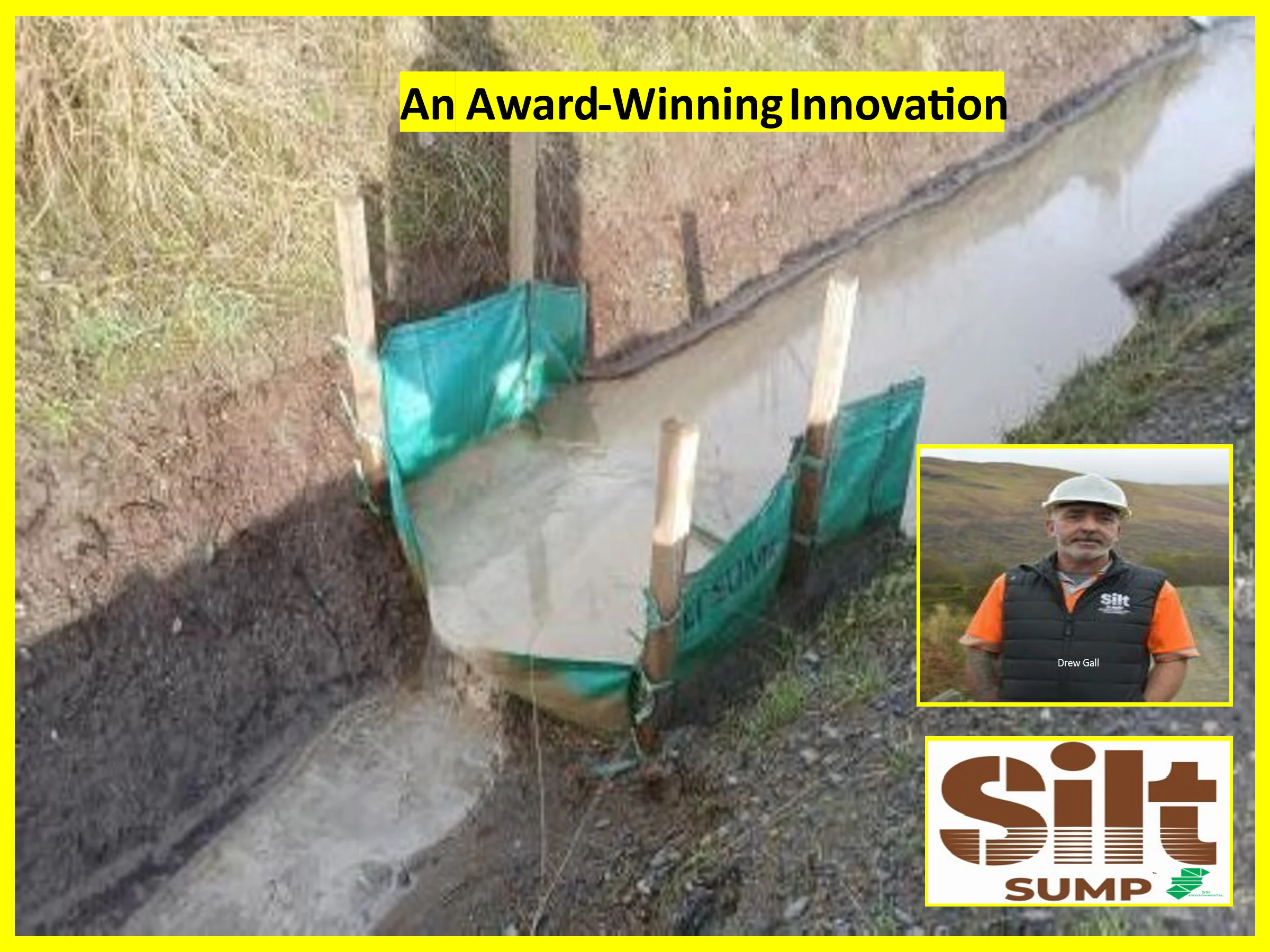
The SSI Silt Sump is a patented sediment management system developed in Ireland by SSI Environmental. It provides a self contained, deployable sedimentation chamber that intercepts turbid runoff from disturbed ground, allows silt to settle, and discharges clear water downstream.

The Silt Sump has been recognised with industry awards, featured on YouTube, and deployed on hundreds of Irish construction sites, from road schemes and windfarm developments to river bridge works and major infrastructure projects. It is a proven Irish innovation that addresses the specific challenge of managing high turbidity runoff in the wet Irish climate.

Key Advantages

  • Rapid deployment: can be installed and operational within hours of arriving on site.
  • Self contained: does not require existing drainage infrastructure to function.
  • Scalable: sized to the runoff volume and site area.
  • Demonstrably effective: reduces turbidity in outflow to NTU levels acceptable for discharge.
  • Removable: can be moved between phases or projects.
  • Patented Irish design: not a generic geotextile bag but a purpose engineered system.

Terrastop Silt Fence System

The Terrastop silt fence is SSI's specification grade geotextile silt fence system for perimeter and intermediate sediment control on construction sites. Silt fence is the most widely used sediment control measure on Irish construction sites and is referenced in EPA Construction Guidelines as a primary control method.

How Silt Fence Works

Silt fence consists of a woven geotextile fabric attached to timber or metal stakes, installed along site boundaries and across drainage paths. Runoff passes through or over the fabric. The geotextile retains fine sediment particles while allowing water to permeate. Accumulated sediment builds up against the upslope face of the fence.

Terrastop Silt Fence Specification

  • Geotextile: woven polypropylene, UV stabilised for extended site service life.
  • Typical height: 600mm to 900mm above ground level.
  • Stake spacing: typically 1.5 to 2.0m depending on flow velocity and sediment load.
  • Filtration: 200 to 400 micron equivalent aperture, retains fine silts while allowing permeation.
  • Ends: turned upslope to prevent bypass flow around fence ends.

Where Silt Fence Is Used

  • Site boundary perimeter where runoff could leave the site boundary and reach a drain or watercourse.
  • Intermediate lines across slopes to reduce flow velocity and intercept silt before it reaches a low point.
  • Around stockpiles of excavated material vulnerable to rainfall erosion.
  • Adjacent to silt sumps as pre treatment before the sump chamber.

Sediment Control Range: Full Product List

ProductApplicationScaleKey Feature
SSI Silt Sump (patented)Active site runoff managementMedium to large sitesDeployable sedimentation chamber; patented Irish innovation; award winning; YouTube featured
Terrastop Silt FencePerimeter and slope sediment controlAny size siteSpecification grade woven geotextile; UV stabilised
Coir Mesh Erosion BlanketSlope stabilisation and erosion protectionAnyBiodegradable natural coir fibre; stabilises disturbed slopes while vegetation establishes
Straw / Wood Fibre Erosion BlanketGentle slope stabilisationAnyCost effective for low gradient slopes and revegetation areas
Settlement Pond LinerLarge volume runoff settlementLarge sites, infrastructureContainment liner for purpose made settlement ponds on large schemes
Check Dams / Straw WattlesDrainage channel sedimentationSmall drainage channelsIntercept silt in existing drainage channels on or adjacent to site
Sediment Sock / Drain GuardDrain inlet protectionAnySee our stormwater drain protection guide for drain inlet specific products

Coir Mesh Erosion Blankets

Coir mesh erosion blankets are biodegradable mats of woven coir (coconut fibre) used to protect disturbed soil surfaces against rainfall impact and runoff erosion. They are used on slopes, embankments, and revegetation areas where vegetation needs time to establish.

Coir Blankets Work By

  • Intercepting rainfall and reducing its impact energy before it reaches the soil surface.
  • Reducing surface water velocity and therefore its ability to detach and transport soil particles.
  • Providing a matrix for vegetation establishment; grass or wildflower seeds sown through the blanket germinate and root into the coir mesh.
  • Biodegrading naturally over 2 to 5 years as vegetation establishes; no removal required.

Coir is preferred over synthetic erosion mats for most Irish applications where long term vegetation establishment is the goal. Synthetic mats must be removed and disposed of; coir decomposes and adds organic matter to the soil.

EPA Construction Guidelines

The EPA Guidelines on the Prevention of Pollution at Construction and Demolition Sites require that:

  • All sites disturbing more than 0.5 hectares of ground implement a formal erosion and sediment control plan (ESCP).
  • The ESCP identifies sediment sources, pathways, and receiving water bodies, and specifies controls for each.
  • Silt fences, sumps, and settlement measures are installed before earthworks begin, not after runoff problems emerge.
  • Measures are inspected and maintained regularly, particularly before and after rainfall events.

Inland Fisheries Ireland (IFI)

Inland Fisheries Ireland prosecutes for silt incidents regardless of site scale. Key enforcement triggers:

  • Visible turbidity (brown or grey water colour) in a watercourse downstream of a construction site.
  • Dry season turbidity that cannot be attributed to natural sources.
  • Smothered spawning gravels; IFI carries out underwater surveys in sensitive rivers.
  • Reports from the public or community groups near the site.

Water Framework Directive (WFD)

Ireland's WFD obligations require that no water body deteriorates in ecological quality status. Repeated silt incidents from a construction site can trigger local authority action under WFD enforcement powers.

Who We Work With

  • Civil engineering contractors: road schemes, motorways, rail, water services.
  • Windfarm developers and their site contractors: access tracks, turbine pads, cable routes.
  • River and infrastructure projects: bridge works, culvert replacement, flood defence.
  • House building developments: all major residential developments require an ESCP.
  • Commercial developers: industrial estate earthworks, large car park construction.
  • Local authorities: roads, drainage, and public realm earthworks.

Frequently Asked Questions

  • What is the difference between silt fence and a silt sump?
    Silt fence is an above ground barrier that intercepts surface runoff and retains sediment on the upslope face. A silt sump is a chamber or pond where turbid water is retained and the sediment settles before clear water is discharged. Silt fence is used on slopes and site boundaries; a silt sump treats the larger volumes of runoff that silt fence has failed to retain fully, or where large areas of disturbed ground generate high volumes of turbid water.
  • Do I need an erosion and sediment control plan for my site?
    Any site disturbing more than 0.5 hectares of ground under EPA Construction Guidelines should have a formal ESCP. In practice, any site near a watercourse should have at minimum a written record of the sediment control measures in place. SSI can assist with ESCP development.
  • How long does silt fence last?
    Terrastop silt fence is UV stabilised for an extended service life. In standard conditions, it remains effective for 18 to 24 months. It should be replaced when the geotextile is clogged, physically damaged, or has accumulated sediment to more than one third of its height.

Silt & Sediment Control Enquiry: SSI Environmental

SSI Environmental supplies the Terrastop silt fence system, the patented SSI Silt Sump, coir erosion blankets, and full sediment control solutions to construction sites across Ireland. Contact us for project specific advice and quotation.

01 866 5676   |   enquiries@ssienvironmental.ie

image004

The Silt Sump

patent protected, award winning, practical, and sustainable innovation which promises to be a gam[...]

Read More

CORI MESH

COIR MESH

CoirMesh™ coir erosion control blankets are open weave, pure coconut, meshes that offer the str[...]

Read More
EROSION GUARD

EROSION GUARD

Erosion is a common challenge on construction sites. Without grass, bushes, trees or other vegeta[...]

Read More
15

SILT FENCE

Specialised silt fence fabric used as an entrenched interceptor fence to control pollution caused[...]

Read More
Silt Curtin pdf 1

Silt Curtain

Floating silt curtains are designed to control and manage sediment flow within water.In brief, fl[...]

Read More